
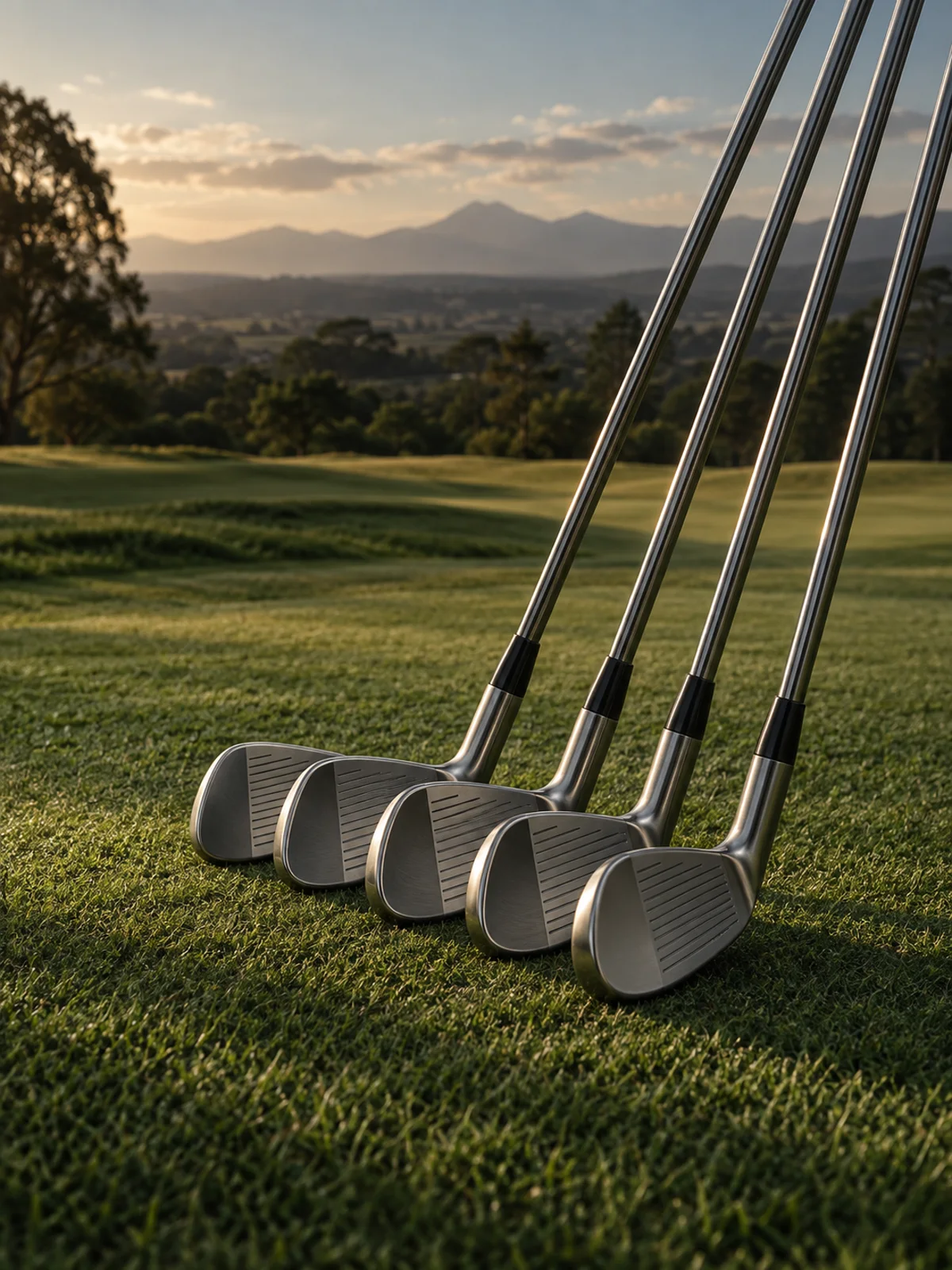
The best first golf clubs are the ones you can swing comfortably, understand clearly and afford to practise with. Before buying in Kenya, confirm handedness, exact set contents, club length, shaft details, condition, seller terms and total delivered price. Brand alone cannot tell you whether a set is right.
This guide is general buying information. A qualified coach or fitter who sees you swing can give advice that a product page cannot.
What clubs does a beginner actually need?
A useful starter setup normally covers tee shots, longer shots, approach shots, short shots and putting. You do not need every possible club immediately. The R&A’s equipment rule sets a maximum of fourteen clubs during a round; it does not require fourteen.
Ask a coach which combination supports your current lessons. A smaller set might include a forgiving long club, several irons, a wedge and a putter. The exact makeup depends on the player and should not be chosen from a generic list alone.
Seven checks before you pay
1. Right-handed or left-handed
Do not guess from the hand you write with. Try both orientations with guidance if you are uncertain. Confirm that every club in a mixed used set faces the same way.
2. Exact set contents
Request a written list of every club. “Ten-piece set” may count a bag or headcovers as pieces. Compare club for club, not headline number for headline number.
3. Length and alterations
Ask whether the clubs are standard length or have been shortened, lengthened or re-shafted. Height is not the only fitting input; posture, arm length and delivery matter too.
4. Shaft material and flex
Graphite and steel can feel different, while labels such as regular or stiff are not fully standardised across manufacturers. Treat the label as a specification to investigate, not a personal recommendation.
5. Grip size and condition
Worn, shiny or cracked grips can slip and add immediate replacement cost. Grip thickness also changes how the club feels in your hands.
6. Head and shaft condition
For used clubs, inspect faces, grooves, soles, ferrules and shafts. Look for cracks, dents, rust, loose heads and suspicious repairs. Ask for clear photographs of the actual item, not only catalogue images.
7. Returns, warranty and provenance
Get the seller’s terms in writing. Request exact model information and proof of purchase where available. A serial number or logo by itself does not guarantee authenticity. If the price is implausibly low and the story is unclear, walk away.
New package set or used clubs?
A new package set offers simplicity: the clubs are designed as a group, condition is known and seller terms may be clearer. Local specialists such as Craig’s show that complete packages are available in Kenya.
Used equipment can offer better specifications for the same budget, but it takes more knowledge to inspect. Marketplace volume does not equal quality assurance. If you are new, bring an experienced golfer or ask a professional to inspect the set.
Individual clubs can also be a sensible route. Review irons, putters, wedges and drivers by purpose rather than assuming one brand must fill the entire bag.
Questions to send the seller
- What is the exact model and model year?
- Which individual clubs are included?
- Are they right- or left-handed?
- What are the shaft material, flex and club lengths?
- Have any clubs been altered or repaired?
- Can you send current photographs of faces, soles, shafts and grips?
- What is the final delivered price in KSh?
- What return or warranty terms apply?
Save the answers. If the delivered product differs, written details are more useful than a phone-call memory.
Common first-set mistakes
Buying for distance only
One long shot during a trial does not prove that a club is consistent. Look for manageable weight, predictable contact and useful gaps between clubs.
Spending the full budget on equipment
Reserve money for lessons, range balls, green fees and transport. Clubs do not improve in the cupboard.
Copying a professional golfer’s setup
Tour players choose equipment for elite speed and delivery. Their specifications are not automatic recommendations for a beginner.
Ignoring the putter and wedge
Beginners often focus on the driver, yet short shots and putting appear repeatedly during a round. Give those clubs proper attention.
Frequently asked questions
How much should a beginner golf set cost in Kenya?
There is no universal figure. Compare complete contents, condition and final delivered price. Current Kenyan retailers and marketplaces span a wide range, so define your learning needs before setting a maximum.
Are graphite shafts better for beginners?
Not automatically. Graphite can be lighter, but weight, flex profile, length and the player’s swing all matter. Try clubs or seek fitting advice.
Can I start with second-hand golf clubs?
Yes. Many golfers do. Inspect condition and fit carefully, verify what is included and include any regripping or repair in your total cost.
Sources and further reading
- The R&A: Rule 4, the player’s equipment
- Decathlon Kenya: local club and kit categories
- Craig’s: package-set examples in Kenya
Sources checked 22 September 2026. Product availability and prices change.
Talk to Karibu Golf